


From 2017 to 2019, several changes to how Celotex PIR boards are classified took place. This was mainly due to the lambda values of Celotex products, and compliance issues regarding them. But what were the changes, and how do they affect you? Here at Insulation Superstore, we’ve put together a quick guide to the changes regarding Celotex PIR board classifications, and what they mean.
Celotex statement – November 2017

In November 2017, Celotex released a statement regarding recent compliance issues with their 4000 and 5000 range products. The company issued the statement for products manufactured between 2009 and October 2017, and potentially even earlier.
The issue regarding the 4000 and 5000 Celotex PIR boards was that the declared lambda value had been understated. This was by:
0.001 W/m/K2 in the 4000 range, and 0.001-0.002W/m/K2 in the 5000 range.
What is lambda value?
Manufacturers use the lambda value in insulation products to determine the product’s insulating capacity. The lower the lambda value, the higher performing the product is in regards to insulation. The lambda value is used to calculate the R-value of a product, which defines the thermal resistance of a product. The higher the R-value, the better the insulating properties it has, as well as the increased resistance it has to heat transmission.
What did this mean for Celotex products?
The understated lambda values led the company to declare the 4000 and 5000 Celotex products as more insulating than they actually were. Therefore, Celotex took time to review and retest its products to come up with a revised system and classification process.
The result was that Celotex changed the classes of a number of its products, in line with the BBA certification. The products changed as follows:
- All XR4000 products, GA4000 products above 100mm thickness, and Crown-Bond and Crown-Fix products would remain the same, in the 4000 and Crown ranges. These would have a declared lambda value of 0.022 W/mK.
- All other current products in the 4000 range (TB4000, GA4000, PL4000 and CW4000) manufactured after December 2017 would be marketed as a new range, Celotex 3000. These would have a declared lambda value of 0.023 W/mK2
- Any products in the 5000 range would remain suspended.
Celotex update – December 2018
Following changes in manufacturing and Celotex PIR board classifications, the brand released further updates. The insulating capacities of products were increased by the company to match the original lambda values, which had been previously understated.
Therefore, the company has reinstated all products that it had previously downgraded to the Celotex 3000 range, returning them to the Celotex 4000 range. However, it has kept the Celotex 5000 range suspended pending further investigations.

Which Celotex PIR boards do you need?
Here at Insulation Superstore, we have a range of different Celotex PIR boards available. Check out our Celotex insulation comparison chart to see how they stack up against one another.
The 4000 range is a selection of multi-purpose rigid insulation boards that you can use on a wide range of applications, including pitched roofs, flat roofs, solid masonry walls, floors and more. Choose TB4000 for boards that are 12-40mm thick, GA4000 for 50-100mm thicknesses, or XR4000 for 110-200mm thicknesses.
If you are looking for insulation boards for cavity walls, the CW4000 products have been designed specifically for partial filling of cavity walls.
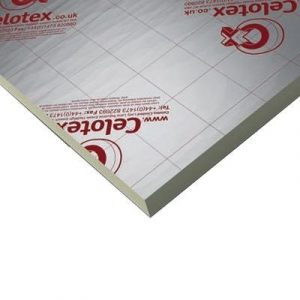
If you have any questions about the most suitable Celotex PIR board for your project or questions regarding the recent re-classification of Celotex PIR boards, feel free to call our team on 01752 692 206 or use the live chat and they will be happy to help.
Was this guide useful?
Mentioned in this product guide: